
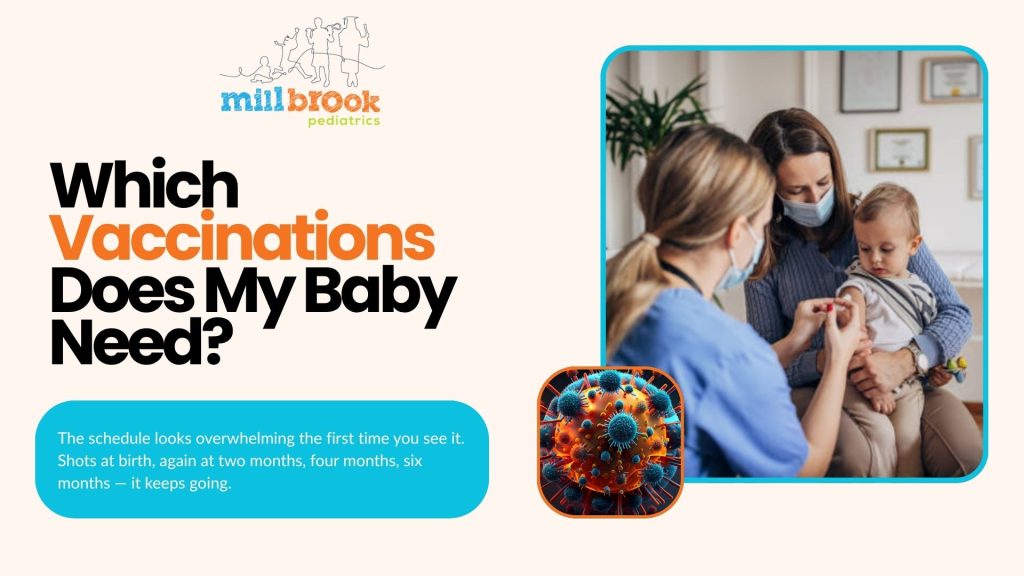
The schedule looks overwhelming the first time you see it. Shots at birth, again at two months, four months, six months — it keeps going. But each vaccine falls where it does for a specific reason, and once you understand the timing, the whole thing gets a lot less stressful.
Below is the current CDC-recommended schedule, plus what adults in your household need to get before a new baby arrives.
What Vaccinations Do Newborns Get?
Most parents aren’t thinking about the 12-month visit. They’re thinking about day one.
Vaccines for newborns at birth start before you leave the hospital. The hepatitis B vaccine (HepB) is given within the first 24 hours. Hepatitis B spreads through blood and certain body fluids — a newborn can contract it during delivery from an infected mother or through exposure later in life. The birth dose closes that early window.
That’s the only shot on day one. You won’t be back until the two-month visit.
The 2-Month Visit
This is where things get busier. At two months, your baby typically receives:
- DTaP — diphtheria, tetanus, and pertussis (whooping cough)
- IPV — polio
- Hib — protects against Haemophilus influenzae type b, a bacterium that can cause meningitis and bloodstream infections
- PCV15 or PCV20 — pneumococcal disease (pneumonia, meningitis)
- RV — rotavirus, given orally; causes severe diarrhea and vomiting in young infants
- HepB — second dose
Six vaccines sounds like a lot. Practically, several are administered together in one injection, which results in less than the number of diseases counted in terms of shots. Your pediatrician will explain everything beforehand.
4 Months and 6 Months
The vaccines for babies that were started earlier are repeated again at four months. At six months, the following vaccinations are added:
Influenza (flu) – recommended starting at six months, then yearly thereafter
COVID-19 – recommended for infants six months and older
It is essential to note how important it is to vaccinate against influenza at six months since infants younger than one year old are most hospitalized because of the flu. Unlike older people, a six-month-old baby cannot explain to you why he finds it hard to breathe at night.
12–18 Months
Several vaccines are administered during this time:
MMR – measles, mumps, and rubella
Varicella – chickenpox
Hepatitis A – two doses beginning at 12 months
PCV and Hib – last doses, depending on the product used previously
It is necessary to debunk certain misconceptions about MMR, a vaccine that has suffered from disinformation for far too long. Its correlation with autism was proven to be completely wrong; the study from 1998 was even retracted.
Vaccines to Get to Be Around Newborns
This is often the part families only consider when a family member actually gets sick.
Newborns under two months have no vaccine protection yet. They’re entirely dependent on the people around them. Vaccines to get to be around newborns—sometimes called “cocooning” — include:
Tdap vaccine – any adult not up-to-date needs one at least two weeks before the baby comes. Whooping cough will kill babies. It is easily spread by adults who don’t know they’re infected since they show symptoms that just look like a bad cough.
Influenza Vaccine – anyone who’s in contact with a newborn during influenza season needs to be up-to-date with vaccinations.
COVID-19 vaccine – this is recommended as well for all household contacts.
Maternal RSV vaccine – administered while pregnant, it transfers antibodies to the newborn before birth. Check with your OBGYN to see if this is possible depending on when you give birth.
If you’re grandparents, siblings, babysitters, or anyone close to the child, you must be up-to-date with all those vaccines. If a baby catches whooping cough before getting the DTaP shot, they end up in intensive care. Getting vaccinated is the simplest way to avoid this complication.
Common Questions
Is my baby going to be in pain?
Yes, but just for a minute. Most babies cry for only one minute following an immunization. Acetaminophen can aid in the discomfort following the immunizations. You should consult your pediatrician regarding the right dosage prior to the visit.
Should we delay our child’s vaccination?
Postponing a child’s vaccination is like opening the door to more harm. Both the CDC and the American Academy of Pediatrics discourage the use of other vaccination schedules. If you have any specific concerns regarding the use of a certain vaccine, talk to your pediatrician instead of delaying the immunization.
My baby is sick. Can we delay the visit?
If your baby is only suffering from a mild cold, there is no need to worry and postpone the schedule. Any significant signs of fever or severe illnesses can be cause for concern. Your pediatrician will evaluate the condition during your visit.
Scheduling at Mill Brook Pediatrics
At Mill Brook Pediatrics, you will receive the necessary information concerning each vaccine and how it helps protect your baby. We provide vaccines for babies ranging from hepatitis B shots at birth to all the other visits in between. To schedule your


0 Comments