
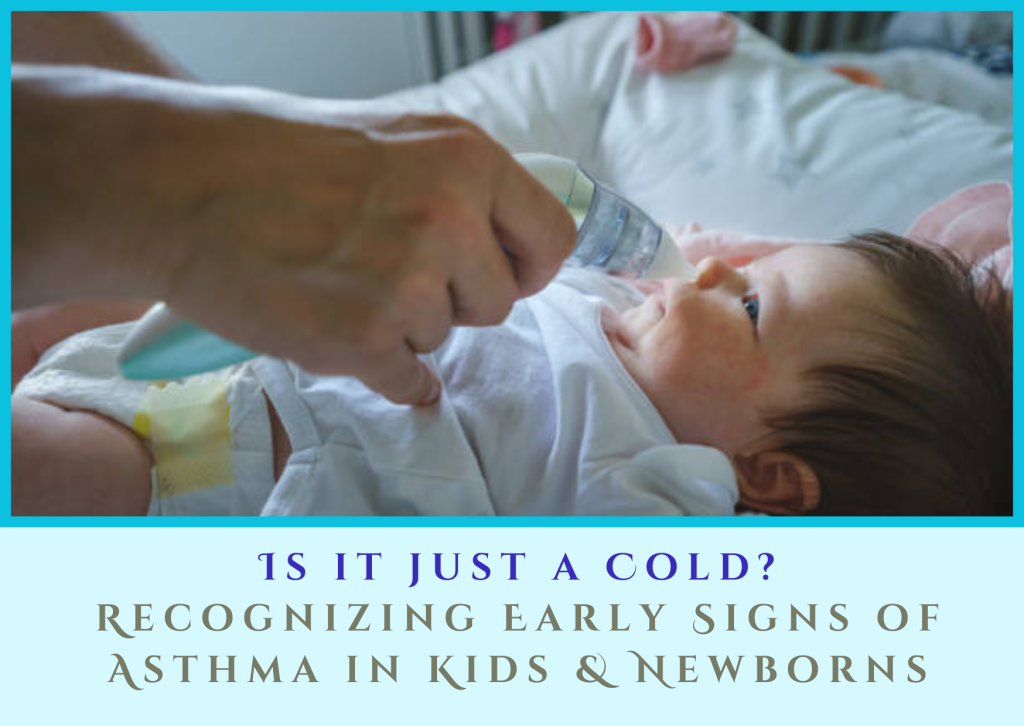
Is it just a Cold? Recognizing Early Signs of Asthma in Kids & Newborns
It’s 2 AM. Your baby is coughing again — that same tight, barky cough that started three days ago. You’ve already Googled “newborn cold remedies” twice this week. You’ve done the humidifier, the saline drops, and the elevated mattress trick.
Nothing is working. And honestly, this cough sounds different from last time.
Most parents land here eventually: is this just another virus, or is something else going on? The answer matters more than most people realize, because asthma that goes unrecognized in the first few years does real damage to developing airways—not just this week, but years from now.
At Mill Brook Pediatrics, we work with families in the Sudbury area every day who are trying to answer the same question: how do you know if your newborn has asthma or if it’s just another cold? This guide walks you through what to watch for at every age.
Newborn Asthma Symptoms: What’s Normal and What’s Not?
Diagnosing asthma in infants is genuinely hard — even for pediatricians. Newborn airways are already tiny, so any inflammation or tightening shows up fast and dramatically. The catch: many other conditions look identical.
That said, there are specific newborn asthma symptoms that should raise a flag:
Rapid breathing—more than 60 breaths per minute in a newborn, or 40–50 in a baby over 6 months, is worth tracking. Count for a full minute when they’re calm, not crying.
Chest retractions — Watch for the skin visibly “sucking in” around the ribs or at the base of the throat with each breath. This means your baby is working harder than usual to get air in.
Poor feeding—A baby who keeps pulling away from the breast or bottle, or falls asleep mid-feed from exhaustion, may be struggling to breathe and eat at the same time.
Persistent fussiness or lethargy—low oxygen is uncomfortable. If your newborn seems more irritable than usual and nothing obvious explains it, breathing difficulty is worth ruling out.
One thing to note: a true diagnosis of asthma is rarely made before age 2, because infant airways behave differently and symptoms overlap with conditions like bronchiolitis. But that doesn’t mean the symptoms should be ignored—it means they need proper evaluation.
Signs of Asthma in 1-Year-Olds: What Changes After Infancy
By 12 months, babies are mobile. They crawl, pull up, and take early steps. That activity level makes signs of asthma in 1-year-olds easier to spot—because now you can see how their body responds to physical effort.
Watch for:
Wheezing — A high-pitched whistling sound when they breathe out. Not every wheeze is asthma, but recurring wheeze — especially with colds — is a pattern worth discussing with your pediatrician.
Tiring unusually fast — A 1-year-old who sits down after a few minutes of crawling, or who gets winded from mild play, may have restricted airflow.
Colds that always “go to the chest” — If every respiratory illness in your child settles into the chest and lingers for 2–3 weeks, that pattern is a clinical signal. It’s not just bad luck.
The “every cold hits hard” pattern is one of the most overlooked early signs. Parents often chalk it up to daycare germs. But when it happens consistently, and the cough outlasts the virus by weeks, asthma becomes a serious consideration.
Decoding the Childhood Asthma Cough
The childhood asthma cough has a specific character that sets it apart from a regular cold cough. Once you know what to listen for, it’s hard to miss.
Why it’s worse at night: Asthma flares between 2 AM and 4 AM for three compounding reasons. Cooler air irritates inflamed airways. Lying flat increases mucus pooling and airway pressure. And the body’s natural anti-inflammatory hormones (cortisol) drop to their lowest levels overnight. The result: a child who seemed fine at dinner is coughing hard at 3 AM.
Trigger-based coughing: Asthma coughs often kick in at predictable moments — after laughing hard, during or after running, when entering a dusty room, or around pets. This cause-and-effect pattern is a meaningful diagnostic clue.
The dry, persistent cough: Unlike a cold, which produces mucus and typically resolves, an asthma cough is often dry and hacking. It can stick around for weeks with no other cold symptoms. Parents describe it as “the cough that won’t leave.”
Why Early Diagnosis Matters (The Mill Brook Pediatrics Approach)
A lot of parents ask how to know if their newborn has asthma, expecting a simple test. The honest answer: it’s rarely one test. In young children, diagnosis is more of a clinical process.
At Mill Brook Pediatrics, we use a few practical approaches:
Trial medications: Since toddlers can’t perform spirometry (the standard lung function test that requires controlled breathing), we often use a “trial of treatment” method. If a child’s symptoms respond clearly to a bronchodilator like albuterol, that response is itself diagnostic information. Improvement that’s too consistent to be a coincidence is clinically meaningful.
Pattern tracking: We ask parents to log when coughs happen, what preceded them, and how long they last. A month of notes is more useful than a single office visit where the child happens to be symptom-free.
Family history: Asthma doesn’t appear in isolation. If a parent has asthma, or if the child has eczema or seasonal hay fever, the risk is significantly higher. These conditions — asthma, eczema, and allergic rhinitis — cluster in families because they share the same underlying immune mechanism (atopy).
Early diagnosis matters because untreated asthma does damage over time. Repeated inflammation and airway remodeling in early childhood can affect lung development in ways that carry into adulthood. Catching it at age 1 or 2 rather than age 7 gives you years of better management.
Action Steps for Parents
You don’t have to wait for a crisis to act. Here’s what to do right now:
1. Keep a symptom log. Note the date, time, what your child was doing, and how long the cough lasted. Patterns in this data — night coughs, post-exercise episodes, reactions after visiting a friend with a dog — give your doctor real information to work with.
2. Check your home environment. Common asthma triggers include cigarette smoke (including secondhand), dust mites in mattresses and soft toys, mold, and strong fragrances from cleaning products or air fresheners. Reducing these doesn’t require a diagnosis — it’s worth doing regardless.
3. Don’t wait for it to get “bad enough.” Parents often hold off on seeing a specialist because symptoms seem manageable. But the goal of early intervention isn’t just to stop the acute cough — it’s to prevent the airway damage that happens from repeated, untreated inflammation.
Breathing Easier Starts with One Visit
Newborn asthma symptoms, recurring chest colds in toddlers, the childhood asthma cough that won’t quit — none of these are things to monitor indefinitely on your own.
The difference between asthma that’s well-managed from age 2 and asthma that goes undiagnosed until age 8 isn’t just 6 years of coughing. It’s 6 years of airway inflammation, disrupted sleep, missed play, and a kid who quietly learns to do less because breathing is hard.
If you’re worried about your child’s breathing, schedule a consultation with the team at Mill Brook Pediatrics. You don’t need to wait until it gets worse to get answers. Most parents who come in say the same thing afterward: they wish they’d come in sooner.
Mill Brook Pediatrics specializes in pediatric respiratory care for infants, toddlers, and children in the Sudbury area. Early evaluation of newborn asthma symptoms and childhood breathing concerns is a core part of what we do.
0 Comments